
What Are the Benefits of Office Pods in Open Offices?
Blog
Office pods add enclosed, task-specific spaces to open offices without changing the entire workplace layout. They can support private calls, focused work, video meetings, and short conversations that do not need a large conference room. Their value is not simply having another enclosed space. It is giving employees a suitable place to switch environments when work requires more privacy, fewer distractions, or a more controlled setting. When pods are matched to real activities, they can also help the wider office remain more comfortable for collaboration.
More Privacy for Calls, Conversations, and Sensitive Tasks
Open desks make communication easy, but they are not the right setting for every conversation. A client call, interview, performance discussion, or personal matter may need more separation than a desk in a shared area can provide. Office pods create a nearby place for these activities, so employees do not have to leave the floor or search for an empty room.
Private Calls and Video Conversations
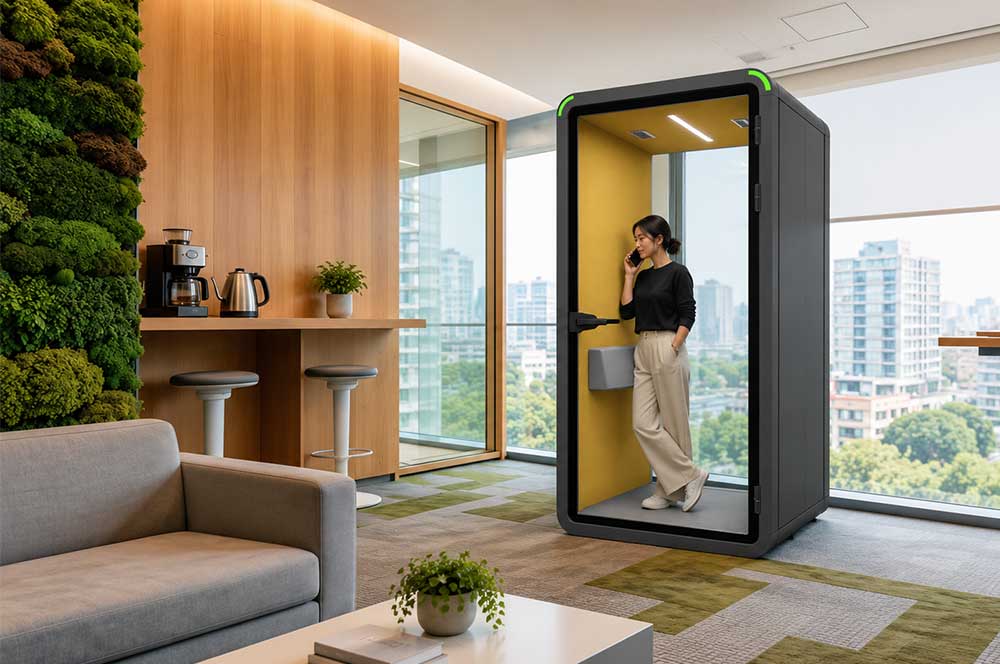
A single-person office pod can provide a more controlled setting for supplier calls, client conversations, remote check-ins, and video meetings. Moving these activities away from shared desks can reduce speech spill into nearby workstations and make it easier for the caller to concentrate on the conversation.
This benefit also reaches beyond the person inside the pod. When frequent calls move out of the open area, nearby employees have fewer conversations to work around. The result can be a calmer shared floor without removing the accessibility and energy of an open office.
One-to-One Discussions
Manager conversations, interviews, feedback sessions, and short consultations often need more separation than an open desk can provide. A two-person pod can support these discussions while keeping larger meeting rooms available for group work, presentations, or training.
The right level of privacy depends on the activity. Pod size, glazing, door construction, placement, screen orientation, and surrounding noise all affect the experience. A pod can support greater speech and visual separation, but it should not be treated as a guarantee of absolute confidentiality.
Sensitive Work Needs More Than a Quiet Corner
Employees may also need a separate place to review documents, prepare for an important call, or work on information that should not be visible to people passing by. In these situations, privacy is not only about sound. Sightlines, screen position, furniture layout, and internal lighting can all influence how suitable the space is.
Office pods work best when companies combine them with clear expectations for device security, document handling, and shared use. The enclosure adds a useful layer of separation; workplace policies remain responsible for the information handled inside it.
Office pods can be useful for:
- Client, supplier, and personal calls
- Interviews and one-to-one discussions
- Video meetings near busy workstations
- Preparing documents away from passing traffic
Fewer Distractions for Focused Work
Open offices support collaboration, but continuous conversation, movement, and online meetings can make demanding work harder. Office pods give employees another setting for tasks that need a temporary break from these distractions.
A Dedicated Place for Demanding Tasks
Writing reports, reviewing detailed documents, planning projects, analyzing information, and preparing presentations can require more sustained attention than an open workstation offers. A pod gives employees a quieter, more defined place for these short focus sessions without requiring a permanent private office.
The purpose is not to move every employee into an enclosed room. Shared desks remain useful for teamwork, quick questions, and everyday communication. The benefit of an office pod is the ability to switch between open and enclosed settings as the task changes throughout the day.
A Benefit for the Wider Team
Focused work affects the whole office, not only the employee who needs quiet. When someone moves a concentration-heavy task or extended call into a pod, people at nearby desks may face fewer audible conversations and fewer cues that they should avoid interrupting a colleague.
A balanced office gives each activity an appropriate setting. This makes it easier for teams to collaborate when collaboration is useful and step away when a task requires more control.
| Work setting | Best use |
|---|---|
| Open desk | Collaboration, quick questions, and routine work |
| Office pod | Calls, focus sessions, and private conversations |
| Meeting room | Longer group meetings, presentations, and training |
Better Video Meetings Without Disrupting the Office
Video meetings can be difficult in an open office. Background conversations, visible movement, and limited desk space may affect both the person on the call and colleagues sitting nearby. An office pod creates a more controlled setting for remote communication without requiring a dedicated room for every employee.
A More Suitable Setting for Remote Work
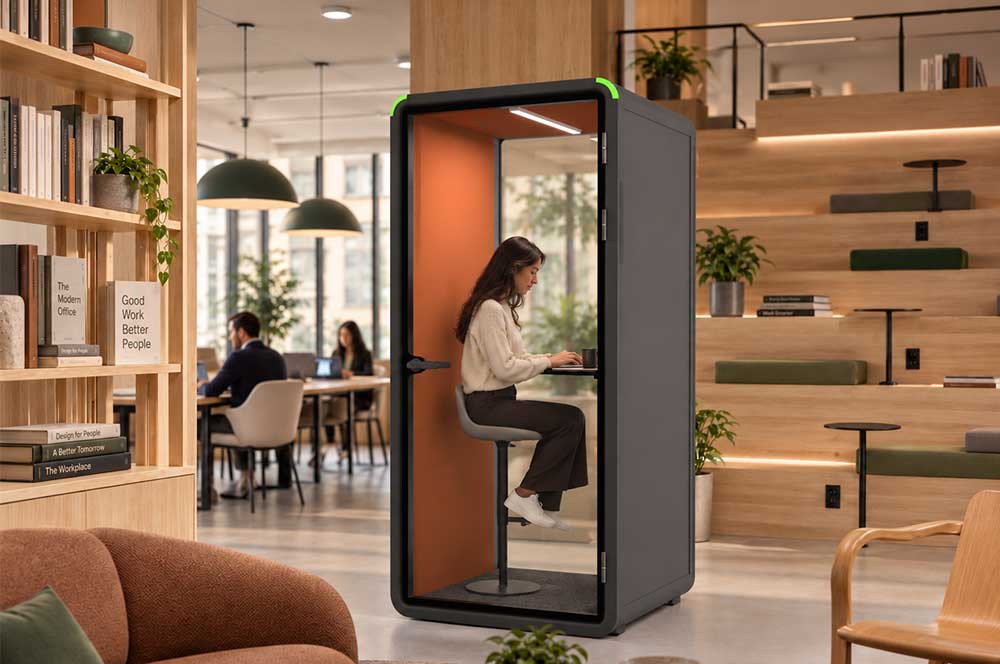
A pod can give employees a defined place for client calls, cross-location meetings, interviews, and online presentations. With suitable lighting, ventilation, power, seating, and a work surface, it can support a more comfortable session than an improvised call at a shared desk.
The space should suit the expected use. A quick individual check-in may only require a compact phone booth, while a longer presentation or shared call may require more room, a table, and seating for additional participants.
Keep Calls from Taking Over the Floor
When frequent online meetings take place inside a pod, nearby desks are less exposed to speech, camera activity, and repeated interruptions. This can help the open area remain better suited to collaboration and routine work. Before specifying a pod for video meetings, review:
- Expected call length and number of users
- Work surface, power, and charging needs
- Lighting position and camera background
- Ventilation and interior comfort
- Door position, screen placement, and nearby sightlines
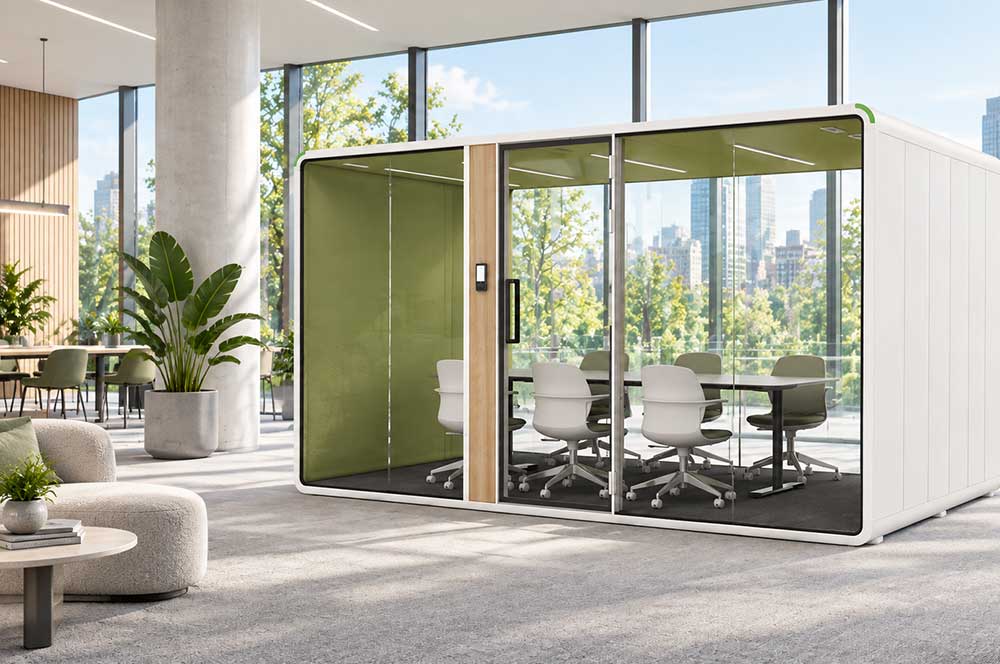
For longer meetings or shared presentations, a larger meeting pod may be more suitable than a compact phone booth. The goal is to match the space to the meeting, rather than treating every enclosed pod as the same type of video room.
Smarter Use of Meeting Rooms and Floor Space
Office pods can help companies use existing rooms more intentionally. In many workplaces, one person uses a large meeting room for a private call, while a two-person conversation happens beside open desks because no smaller space is available. Adding pods creates more useful options between a workstation and a formal conference room.
| Activity | Better-fit space | Why it helps |
|---|---|---|
| Short private call | Single-person pod | Keeps calls out of shared desks |
| Video check-in or solo task | Work pod | Provides a desk-based, lower-distraction setting |
| Interview or one-to-one | Two-person pod | Adds separation without using a large room |
| Project discussion | Small meeting pod | Supports small groups near their team area |
| Training or presentation | Meeting room | Better for larger groups and longer sessions |
This approach does not mean pods should replace every meeting room. Larger rooms remain important for training, presentations, workshops, and meetings with several participants. Pods are most valuable when they handle the smaller, more frequent activities that otherwise compete for those rooms.
Using the right space for each activity can also make it easier to understand where the real gap is. A company may not need another large boardroom; it may need several places for calls, quick discussions, and focused work. Browse M&W office phone booths and acoustic meeting pods to compare spaces for these different activities.
Flexible Private Space Without Permanent Construction
When an office needs more enclosed space, building a permanent room is not the only option. Modular office pods can add a private setting within an existing layout while allowing companies to keep the wider workplace adaptable.
This can be useful for leased offices, growing teams, workplace refreshes, or projects where a fixed room may not suit future needs. A pod can be planned around the activities that happen most often today, then reconsidered if the office layout or team structure changes later.
| Consideration | Modular office pod | Permanent room |
|---|---|---|
| Layout changes | Can support later reconfiguration | Usually fixed in place |
| On-site disruption | May require less building work | Often involves a broader construction scope |
| Best use | Calls, focus, one-to-ones, and small meetings | Larger meetings and permanent functions |
| Project planning | Requires access, power, clearance, and placement review | Requires broader building and fit-out planning |
A modular pod is not always the right answer. A traditional room may be more suitable for frequent large meetings, presentations, or activities that need a dedicated long-term space. The benefit of office pods is flexibility: they can fill the gap between open desks and formal meeting rooms without forcing every private activity into the same type of space.
Before choosing either option, teams should review floor area, circulation routes, ceiling clearance, power access, expected occupancy, and the privacy needed for each activity. These conditions influence whether a pod will be practical and how it should be configured.
More Choice for Different Work Styles
A well-functioning open office does not require everyone to work in the same setting all day. Some tasks benefit from quick interaction at a shared desk, while others need a quieter, more private, or more controlled environment. Office pods add another choice without removing the collaborative value of an open layout.
Match the Space to the Moment
| Employee need | Suitable pod use |
|---|---|
| A private call | Compact phone booth |
| A longer solo task | Individual work pod |
| A manager conversation | Two-person meeting pod |
| A project discussion | Small team meeting pod |
This flexibility can make the office more responsive to daily changes in work. An employee may use a shared desk for most of the day, move to a pod for a client call, then return to a collaboration area for a project discussion. The goal is not isolation. It is giving each activity a setting that makes sense.
Pods can also support employees who prefer more control over noise, visual movement, or interruptions during certain tasks. They are not a replacement for inclusive workplace policies or good management practices, but they can give people an additional environmental choice during the workday.
Plan a Better Mix of Workspaces with M&W
M&W offers office pod options for compact privacy needs, individual work, two-person discussions, and small-team collaboration. Businesses, dealers, and project teams can consider pod size, furniture, finishes, and layout requirements together when planning a workplace project.
Start with the activities that create the most pressure in the current office: frequent calls, limited focus space, overused meeting rooms, or the need for more private conversations. Then identify the expected users, location, quantity, and preferred configuration. This creates a clearer basis for choosing office pods that support how the workplace actually operates.
Conclusion
Office pods help open offices support more than one way of working. They can create greater privacy for calls and sensitive conversations, give employees a better setting for focus and video meetings, and reduce pressure on larger meeting rooms. Their value also comes from flexibility: businesses can add enclosed work settings without relying only on permanent construction.
The right solution depends on how people use the office each day. Start with the activities that need more privacy or concentration, then match pod size, interior features, and placement to those needs. Explore M&W Office Pods for product selection, configuration, and commercial project support.